Choosing An ICT Infrastructure Partner In Saudi Arabia A Proposal Review Checklist

Choose an ICT infrastructure partner by checking what the proposal commits to deliver and what evidence supports those commitments. Review scope, comparable references, responsibility, acceptance tests, warranty and support before comparing price. A strong presentation or familiar client logo should prompt verification, rather than replace it.
For procurement teams, IT managers and project owners in Saudi Arabia, the practical goal is a proposal that can become a clear delivery agreement. Use the checklist below to identify gaps, request written clarifications and compare qualified bidders using weights your team sets in advance.

Start With A Common Project Brief
Give every bidder the same brief and record its revision number. Describe your locations, current infrastructure, users, applications, required completion date and operating constraints. Identify what must remain available during installation and which changes require approval from your IT or facilities team.
For example, an occupied Riyadh office upgrade may need evening access, coordination with the landlord and an agreed switch-over window. This is an illustrative scenario. Ask each bidder to state assumptions about these conditions rather than leaving them buried in a quotation.
Define the scope boundary: structured cabling, active network equipment, communication rooms, integration, or ongoing support. Do not assume cloud migration, backup operation or managed cybersecurity is included merely because the proposal says “ICT infrastructure”.
Review nowa’s ICT infrastructure service overview when defining the requested scope.
1. Check Scope, Quantities And Exclusions
Ask for a bill of quantities: an itemised list of equipment, materials and services. Match it to the drawings and your brief. Specify manufacturer, model or part number, quantity, licence duration and included accessories wherever these affect delivery or cost.
| Check |
Evidence To Request |
| Supply and installation |
Equipment list; cable and outlet quantities; installation labour; approved substitution process. |
| Configuration and integration |
Configuration tasks, systems to connect, compatibility checks and buyer-supplied access. |
| Site dependencies |
Who supplies power, cooling, pathways, internet service, permissions and ready work areas. |
| Licences and recurring services |
Subscriptions, term, renewal owner, included features and expiry consequences. |
| Exclusions and changes |
Explicit exclusions, provisional quantities and written approval process for variations. |
Ask bidders to identify unresolved survey findings and price assumptions. A provisional quantity should remain visible until confirmed. If a replacement product is proposed later, require a documented technical comparison and buyer approval before procurement.
A practical clarification is: “Does the quoted access point price include the required licence, mounting hardware, cabling and configuration?” Do not mark the scope complete until the answer is reflected in the revised proposal.
2. Verify Comparable References And Delivery Capability
Request references that resemble your project in system type, scale, operating environment and integration complexity. A long client list does not explain whether the bidder designed a system, supplied products, installed cabling or maintained the completed infrastructure.
For each reference, ask for the completion period, exact delivery role, systems involved and permission to contact a relevant client representative. Respect confidentiality: a redacted handover extract or client-approved reference discussion may be more appropriate than requesting sensitive drawings.
Ask the reference contact whether the agreed scope was delivered, how changes were handled and whether documentation and support were usable after handover. Record the date and source of the feedback. Treat an uncontactable reference as unverified, rather than assuming success or failure.
Also request the proposed project manager, technical lead and subcontractor roles. Verify any claimed manufacturer authorisation through the manufacturer’s current channel. An individual certification, company partnership and product support entitlement are different forms of evidence.
3. Assign Responsibility At Every Interface
Request a responsibility schedule covering the bidder, buyer, landlord, telecom provider and other contractors where relevant. For each activity, name who performs it, who approves it and what must happen first. Require the bidder to identify subcontracted work and who remains accountable for it.
Pay particular attention to equipment power, communication-room readiness, cable pathways, internet activation, firewall changes and integration credentials. “By others” is incomplete unless the other party and delivery date are recorded.
Use the nowa design development overview as context for discussing drawings and design deliverables.
| Activity |
Delivery Owner |
Approval Owner |
Dependency / Due Date |
| Design and quantities |
________ |
________ |
________ |
| Power, cooling and room readiness |
________ |
________ |
________ |
| Installation and configuration |
________ |
________ |
________ |
| Testing and corrective actions |
________ |
________ |
________ |
| Handover and support activation |
________ |
________ |
________ |
Document the change process too. Each variation should identify the revised scope, price effect, schedule effect and approving person. A conversation on site should not silently change the contract baseline.
4. Agree Testing And Handover Before Installation
Ask what evidence will demonstrate that each deliverable meets the agreed specification. The technical reviewer should choose the test method, conditions and pass criteria for your project. Avoid accepting a generic statement that the system will be “tested and commissioned”.
Examples to discuss include cabling test reports against the agreed specification, a wireless coverage survey under defined conditions, and documented network configuration checks. Where redundancy is included, define an authorised failover test and its recovery expectations. These are proposed review items, not universal test requirements.
For a live-site migration, request the cutover sequence, authorised maintenance window, rollback decision point and responsible contacts. Record third-party dependencies. Review continuity objectives through an agreed design and test plan, rather than treating a promise of uninterrupted service as proof.
Specify the handover pack: as-built drawings, asset and serial-number register, configuration backups, licence records, test results, warranty documents, operating instructions and training records. Agree secure transfer of administrative access and removal or approval of supplier access. List remaining defects with owners and dates; distinguish conditional acceptance from final acceptance.
5. Separate Warranty From Ongoing Support
Review manufacturer product warranty, installation workmanship coverage and paid support separately. A warranty label alone does not establish on-site attendance, replacement stock, software updates or operational troubleshooting. Cisco’s warranty FAQ, for example, distinguishes manufacturing-defect remedies from operational support and notes that coverage depends on the applicable terms.
Check the manufacturer’s terms: Cisco Hardware Warranty Information FAQ.
For the products actually quoted, request the warranty document, duration, start event, exclusions and claim route. Ask who removes a failed device, arranges shipping, installs the replacement and restores configuration. Confirm whether labour, travel and temporary replacement equipment are included.
Check registration and support entitlement requirements before handover. Ask how warranty coverage is preserved if the installation partner changes, and who owns the records. Do not assume one manufacturer’s warranty terms apply to another brand or product family.
6. Demand Measurable Support Evidence
A service-level agreement (SLA) should state service hours, channels, incident priorities, response targets, escalation and any restoration commitments. Response means the supplier begins dealing with the issue; it does not necessarily mean the service has been restored.
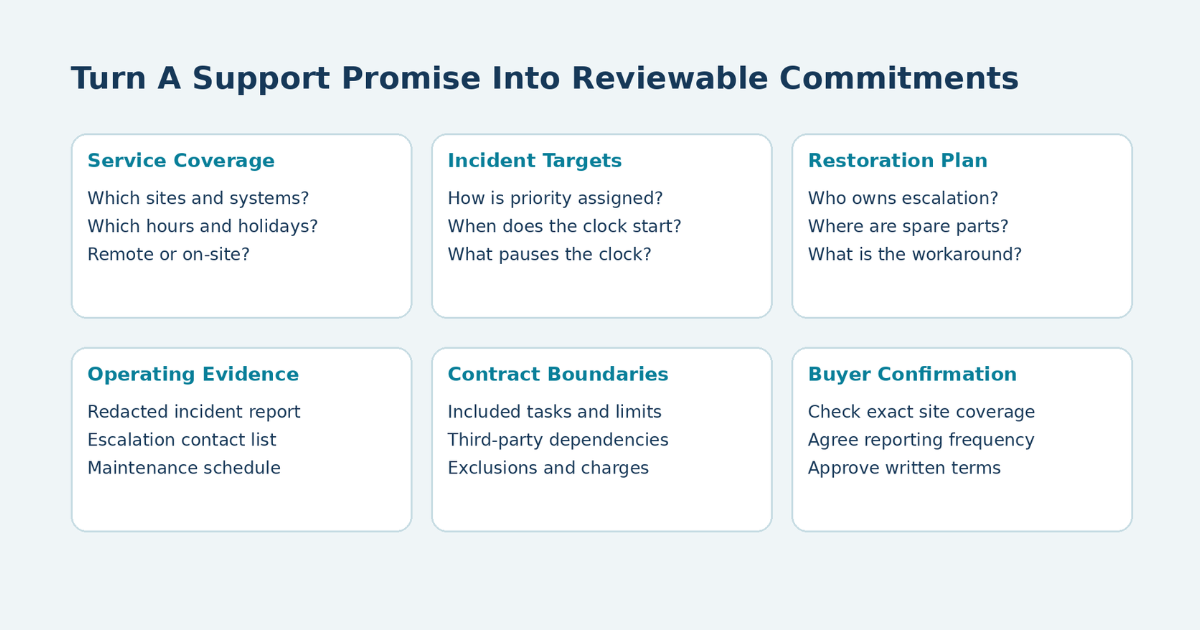
For your Saudi sites, ask where engineers are based, which locations receive on-site coverage and whether travel affects attendance. Clarify weekend and public-holiday arrangements. A local office address is useful context, but is not evidence of the response time available for your facility.
Request a sample redacted incident report, escalation schedule, preventive-maintenance plan and spare-parts arrangement where relevant. If historic performance is offered, ask what period, sites and contract scope the figures cover. An example report demonstrates the reporting format; it does not prove future performance.
Confirm who manages manufacturer cases and telecom incidents. Ask about remote-access controls, patch approval, backups of configurations and service reporting. Put accepted commitments in the agreement, including exclusions and dependency-related delays.
Review nowa’s maintenance service overview, then request the proposed contract terms for your site.
7. Review Saudi Requirements Without Accepting Blanket Claims
Ask your security or compliance owner to identify the requirements applicable to your organisation and project. The National Cybersecurity Authority publishes Essential Cybersecurity Controls (ECC 2-2024). Use the official controls and their scope with qualified advice; do not treat every Saudi commercial project as having identical obligations.
Consult the NCA Essential Cybersecurity Controls and implementation guidance.
Where a requirement applies, ask the bidder to map it to a deliverable, responsible party and verification evidence. “Compliant with Saudi standards” is not an adequate substitute for this mapping. Identify any relevant sector requirements, customer policies or data-handling constraints through the appropriate owner before award.
Ask who controls administrator access, what information a support engineer can view and whether external access or data transfer is proposed. Record approval requirements and exclusions. These questions support procurement review; they do not certify the design or establish legal compliance.
8. Compare Costs On The Same Basis
Normalise quotations before scoring value. Compare the same equipment quantities, licence terms, installation tasks, acceptance evidence and support period. Separate one-time charges, recurring fees, optional services and provisional amounts. Ask whether taxes and delivery charges are included.
Choose a common evaluation period that suits the project. Request renewal assumptions and identify estimates separately from committed prices. Include any buyer-supplied work needed to make the proposed system usable. A lower quotation with omitted licences or testing should first be corrected for scope differences.
Review payment milestones against agreed deliverables and acceptance evidence with your commercial team. Check substitution rules, delay dependencies, proposal validity and change pricing. Do not assume the most expensive bid has the strongest technical offer, or that the least expensive bid is unsuitable.
Use A Blank Comparison Matrix With Buyer-Set Weights
Set mandatory conditions first: for example, complete critical scope, an acceptable security review and required support coverage. Mark each bidder Pass, Fail or Pending against those conditions. A high weighted total must not compensate for failing a mandatory requirement; resolve pending evidence before making an award recommendation.
Then agree criterion weights before reviewing scores. The weights below are intentionally blank. Your IT, procurement and operations teams should allocate a total of 100% according to the project’s priorities. Use one scoring scale and record the evidence behind every score.
| Criterion |
Weight % |
Bidder A 0–5 |
Bidder B 0–5 |
Bidder C 0–5 |
| Scope completeness |
____ |
____ |
____ |
____ |
| Comparable references and team |
____ |
____ |
____ |
____ |
| Responsibility and delivery plan |
____ |
____ |
____ |
____ |
| Testing and handover |
____ |
____ |
____ |
____ |
| Warranty and replacement |
____ |
____ |
____ |
____ |
| Support evidence and SLA |
____ |
____ |
____ |
____ |
| Applicable security requirements |
____ |
____ |
____ |
____ |
| Comparable evaluated cost |
____ |
____ |
____ |
____ |
| TOTAL |
100% |
____ / 100 |
____ / 100 |
____ / 100 |
Suggested scoring guide: 0 = absent or unacceptable; 1 = major gaps; 2 = partly meets the criterion; 3 = meets it with adequate evidence; 4 = meets it with strong evidence; 5 = exceeds a defined requirement in a useful, evidenced way. Mark missing evidence Pending during clarification; if it remains absent at closure, apply the agreed scoring rule consistently.
For each row, weighted points = weight percentage × score ÷ 5. Add the points for a total out of 100. Illustrative calculation only: a buyer-selected 20% weight and score of 3 produce 12 points. Keep an evidence log with the criterion, proposal page, document version, clarification, reviewer and date. Re-score after any material revision.
Close Gaps Before You Appoint The Partner
Send a numbered clarification list and ask each bidder to answer against it. Incorporate accepted responses into the revised proposal or contract schedules. Have your technical reviewer check scope and testing, your operations team check support, and your commercial team check price and terms.
If a bidder cannot substantiate a reference, define a support boundary or accept responsibility for a critical interface, record the unresolved issue. Decide whether it is disqualifying using the conditions agreed before scoring. The final recommendation should explain the evidence, outstanding risks and approval owners.
Preparing an ICT project in Saudi Arabia? Send nowa your site brief, scope boundary and required deliverables through the enquiry form on its consultancy page. Request a written proposal covering responsibilities, acceptance evidence, warranty and support terms so your team can assess it using this checklist.
Contact nowa through the consultancy enquiry form.
Frequently Asked Questions
Can We Shortlist A Bidder Before Every Detail Is Confirmed?
Yes, provided the shortlist records what remains unverified. Use a clarification stage to close gaps in quantities, references, site assumptions and support terms. Do not present a provisional score as a final award decision. Critical technical requirements and mandatory conditions should be resolved before your team approves appointment.
What If A Client Reference Is Confidential?
Ask for a client-approved discussion, a redacted completion record or another agreed way to verify the bidder’s role. Avoid requesting sensitive infrastructure details without permission. Record which evidence you reviewed and its limits. A confidentiality restriction does not prove poor delivery, but the reference should remain unverified until adequate evidence is available.
Does A Local Office Prove Fast On-Site Support?
No. Ask for coverage for the specific site, engineer availability, service hours, dispatch arrangements and travel assumptions. Put any accepted attendance commitment in the support agreement. An address demonstrates a stated location; it does not establish staffing, spare-parts availability or the service target offered under your proposed contract.
How Should We Assess A Bidder Using Subcontractors?
Ask which tasks are subcontracted, who supervises them and who remains contractually responsible for results. Review relevant competence and the escalation route. Include subcontractor dependencies in the delivery schedule and responsibility matrix. Assess the complete delivery arrangement against your requirements rather than accepting or rejecting subcontracting without examining its scope.
Should We Change The Weights After Seeing Prices?
Agree weights before scoring to keep the comparison consistent. If a material scope change requires different priorities, document the reason, obtain buyer approval and apply the revised weights to every bidder. Retain both versions of the evaluation. Resolve mandatory failures separately so a strong commercial score cannot hide an unacceptable critical gap.